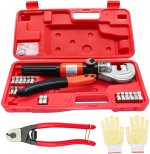
Which would you prefer for your own mower?

I knew there was more than one way to get a rock solid good connection. For me it was just that the hydraulic crimper works best for me as I do lot more just lawn mower battery cables like my household 0000 cables that can have up to 200 amps going through or my truck battery cables that have at least 600+ amps going through them when I starting the motor.

The main point was don't do a poor job of fixing the cables like my example of what the customer did to keep from carrying his cable to get it fixed but ended up in my shop anyways because it failed.
 
ahhhhhh to crimp? or not to crimp? what is the answer....what works best for the application...my not so humble nor honest opinion!
Love the blog! I have learned so much since joining You guys know yer stuff!
Thanks!
 
I always put on the Shrink Sleeve FIRST! Usually Crimp/Solder then cover with Permatex Aircraft Gasket cement, allow to dry and then shrink on Insulation sleeve after trimming any burnt wire insulation. There are many ways to do this.
 
Ah an area that I getting away from. I am trying to be environmentally friendly here but I do know the method but I tend to sweat the joints and let flux draw in the solder. I currently using 63/37 mix. The old way just puts more lead and CO2 in to the environment. The hydraulic puts out only the CO2 I breathe out besides half the time I out Propane anyway.
ACDC huh?
 
As far as the pictures, I will do the properly crimped with solder. I use regular rosin core solder. After the crimp I clamp the hole end of the connector in the vise and heat with a propane torch. The solder flows in nicely and make the connection liquid tight, so don't have a problem with corrosion. Then hit it with a little dielectric grease and then heat shrink. Heating the connector with the torch does little to damage the insulation. The heat shrink will cover it anyway.

Sometimes I use a larger connector and get the over crimp. Then solder and go from there. I am not going to run around town looking for the correct solder lug. (that probably nobody has.) 8 ga wire with a 1/2" hole etc. The little yellow connectors that have them are so flimsy I would not use them.

So far I have not seen the ones I fixed every fail.
 
I use this:View attachment 57614
But, solder is great too but, only use rosin core for electrical connections, any other flux will be acid based and can cause corrosion in the future.
The harbor freight special... I use that too. Works well. Only thing, they have dies for down to 16 or so gauge wire, but not really large dies. Wish they had dies for 0000 wire. I was always thinking of grinding the odd ball small ones to the size I want, but never got to it. The ones you show on the far left look larger than what came with mine.
 
Ah an area that I getting away from. I am trying to be environmentally friendly here but I do know the method but I tend to sweat the joints and let flux draw in the solder. I currently using 63/37 mix. The old way just puts more lead and CO2 in to the environment. The hydraulic puts out only the CO2 I breathe out besides half the time I out Propane anyway.
I prefer soldering my electrical connections because it just makes for a better connection. My thoughts about using Pb alloy solder are, any environmental consequences has already been done in the mining, refining, and manufacture (like E-vehicles, huh?) Besides, there is lead-free electrical solder as well.
 
Lead metal poses no more environmental hazard than any other metal
You can eat it.
Goes in one end and 100% comes out the other
Undergraduate experiment done 1000's or times till ethics committees put an end to it
Only 5 common metals can be injested and come out 100%.
Lead oxides, different story
 
Back
Top