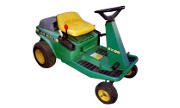
I believe that is nearly the same mower as my RX-95.
On an RX75-style rider (RX63/73/75, SX75, and the close cousins), cutting height and deck level are two different things. Height is the lift lever. Level is the linkage, and on these machines the front is mostly fixed by the pins that sit on the front axle.
Park on a hard, level surface, set the parking brake, kill the engine, and pull the key. Check tire pressure first so a soft tire does not fake a low side.
### Cutting height
The height lever on the right side pulls spring-loaded pins and drops into holes in the quadrant. Typical range is about 1 to 4 inches in half-inch steps. Both pins have to seat fully. Deck gauge wheels are anti-scalp only: set them so they clear the ground by about 1/4 to 1/2 inch at the height you actually mow. They should not carry the deck.
### Level specs
A long-time Deere mechanic who worked these decks gives this target:
- Side to side: outer blade tips within about 1/8 inch of each other.
- Front to rear: front blade tip 1/4 to 3/8 inch lower than the rear tip.
That nose-down pitch is intentional. A perfectly level deck cuts with both ends of the blade at once and uses more power, and it often leaves brown tips.
Measure from a flat floor to the blade tip, not to the deck shell. Turn one blade left-right for side-to-side, then front-rear for pitch. On a twin-blade deck, hold the belt and turn the second blade the same way.
### Side-to-side
This is the only real adjuster. On the deck hanger there is a J-bolt (or an eccentric cam with locknuts, depending on exact year). Loosen the jam nuts, move the J-bolt or rotate the cam until the outer blade tips match, then lock the nuts. Recheck after tightening; these linkages move when you clamp them.
### Front-to-rear
The front of the deck hangs on thick pins that ride on top of the front axle, so there is no normal front draft-rod adjustment like a later tractor. A little pitch change comes from the same J-bolt nuts: loosening them and shifting the bolt slightly is what owners use to take a deck that is only a bit off and put the front 1/4–3/8 inch low.
If the nose is an inch or more low, the adjuster will not fix it. Common causes on these machines:
- Worn front-axle pivot and the pins that locate the deck
- Stretched or worn lift links and rear pins
- Bent or twisted deck shell
Those have to be brought back toward new condition (new bushings, pins, or a straight deck). Running the cam or J-bolt to the end of travel and still being way nose-down is wear, not a missed adjustment.
### After you set it
Recheck side-to-side after any front change, then set gauge wheels for the height you use. A short test strip on flat grass will show a stripe or a washboard long before the tape measure does.
Hope this helps. Respectfully, DBW
"The Second Time, It's Not A Lesson."