Almost hydro-locked from a fuel leak

Thanks Andrewslarge for the tips. I do have a shut off valve installed and as I mentioned early on, I've always been shutting off the fuel and run the engine dry. However, SloMo (I think) suggested this can cause the problem I'm having now because the rubber tip on the needle can dry out and not seal correctly next season. So now I'm going to leave the carb full and rely on the Stabil fuel treatment to keep things fresh.

Just thought of something. For the price I paid for the replacement carb off Amazon, it might be cheaper to just buy a new one each year and replace the carb every spring. JUST KIDDING!!! (Sort of.)

Thanks again.
 
Thanks Andrewslarge for the tips. I do have a shut off valve installed and as I mentioned early on, I've always been shutting off the fuel and run the engine dry. However, SloMo (I think) suggested this can cause the problem I'm having now because the rubber tip on the needle can dry out and not seal correctly next season. So now I'm going to leave the carb full and rely on the Stabil fuel treatment to keep things fresh.

Just thought of something. For the price I paid for the replacement carb off Amazon, it might be cheaper to just buy a new one each year and replace the carb every spring. JUST KIDDING!!! (Sort of.)

Thanks again.
You are correct. The Honda, Briggs, Kohler etc are so cheap….even OEM. It is often cheaper just to replace the carburetor instead of spending, sometimes hours, working on it. What’s your time worth.

I spend the $12-14 for the high quality fuel cut offs.

Just must force myself to remember to turn off the key when engine runs out of fuel. Too many time I go to start the engine and see the key in the run position and a dead battery.
 
This is a Husqvarna YTH18542 riding mower. B&S 18.5 hp engine. 42" cut. Original owner. Bought new 8 or so years ago.
View attachment 73017

Brought it out of storage this morning to do a mow, then changed the oil and other maintenance. While changing the oil, I smelled gas and could see gas dripping from the top of the carborator, down and all over the bowl. No drip from the supply lines. Definetly coming from the top of the carb. Tried to turn over the motor and it was stuck. Tried turning the flywheel by hand and could gear a gurgling noise coming from the air filter inlet. Shut off the gas supply and removed the top cover and the spark plug and fuel began leaking from the cylinder. Turned it over by hand and could see more fuel gushing out of the spark plug hole. Using the key, I turned it over a few revolutions to clear the cylinder. With the gas line still shut off, I replaced the spark plug and turned on the fuel again. It started reluctantly but once it started it ran normally. Shut it off and waited awhile to see if the leak reappeared and it did not. So thinking it was just a sticky needle or something, I reassembled everything and went to start it again and again it was stuck. Tried moving the fly wheel by hand and again could hear fuel gurgling in the cylinder. So cleared it out again, this time leaving the fuel shut off until I was ready to start it so I could move it so my wife could get her car out of the garage. So I moved it back to its storage place and am now trying to figure out my next step.

I was at first tempted to use the battery jumper on it, thinking the battery was a little flat for some reason (keep it on a tender over the winter) but probably a good think I didn't since the cylinder was full of fuel and I could've hydro-locked the engine and cracked the block.

I store the mower with an empty bowl, shutting off the fuel and letting the engine die. I always put in some gas treatment before running it dry. I bought it new and it's never had a whiff of ethanol fuel in it.

I know nothing about carbs so please, talk to me like I'm an idiot. Is there anything I can do to loosen up the sticky "whatever" without having to remove the carb all together? I'm deathly afraid of getting this thing taken apart and not being able to reassemble and make it run again. I posted a pic of the valve cover numbers so you can see what engine it has. Sorry it's sooo big. I might be willing to try putting in a rebuild kit if someone might know what kit it needs. I have the B&S parts manual and it lists a few different kits for different carbs. I'm guessing I would need to order this from B&S directly.

It's funny because I've rebuilt hydrostatic units on these mowers before and had no reluctance to tear into one but you give me a carb and I'm like a blithering idiot.

Thanks for any help.
Block cracking is the last thing that would happen. A bent con rod is more likely. Take pictures with your phone of carb removal and disassembly.....assuming you have a cell phone.....at every step. Don't think you'll remember and skip....take pictures. Different angles. Once apart spray or soak everything in carb cleaner. Pay attention to the float.....plastic or brass....and the float needle. Unlikely that the float has absorbed or become filled with fuel making a not-float anymore but can happen. The needle has a Viton tip...rubber. If the tip is deformed, replace. Using the spray carb cleaner straw....red tube usually....direct and spray into every internal hole you see. Wear eye protection to keep spray from bouncing back into your eyes. Look at your pictures in reverse sequence. Reassemble.
 
The needle and seat "look" good at the end of page 3. If they don't seal, trash time.

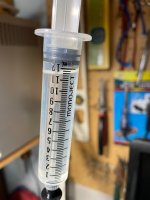
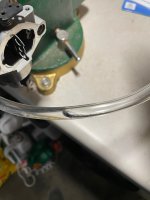
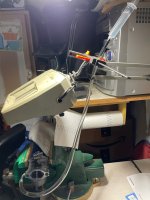
James Condon makes really good engine videos on youtube. He uses trimmer or transparent fuel line temporarily zip tied to say a generator. Squirts fuel into the line which fills the carb bowl. Once the bowl is full and stops accepting, mark a line on the fuel line. Come back in 30 minutes. No movement calls for celebration. Anything else needs attention. Just wanted to clear up what I was trying to say about testing needles/seats in real world scenarios.
 
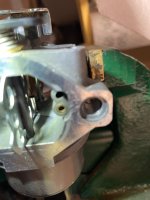
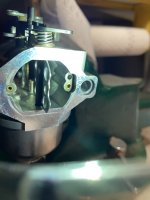
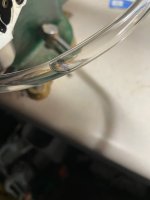
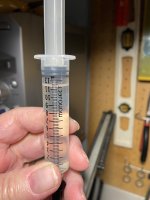
Just finished the real world testing. The first 4 pictures are of the beginning of the test. The last three are after 30 minutes of having fuel sitting in the full bowl and clear fuel line. I saw no change in the fuel level in the syringe or from the mark I made on the clear tubing. The picture inside the throat of the carb show no fuel visible before or after the test so I think the needle is seating as it should with no leaks.
Fuel test 1.JPGFuel test 2.JPGFuel test 3.JPGFuel test 4.JPGFuel Test 1a.JPGFuel Test 1b.JPGFuel Test 1c.JPG
Next is to put it back on the mower and change the oil and see if it will start/run ok. It's only about 40 degrees here today so it will have to wait until Monday or Tuesday.

Clean up time.
 
Cleaning a carb is NOT rocket science. Take a picture of the carb so you can see how all the lever rods and springs go back. Remove the carb. Get a plastic tub to catch the gas and small parts. Remove the bowl by lowering it level so you can see if there is any water or crud. Clean. Remove the float. Take pictures to put it back together. The Use some spray carb cleaner and squirt through the holes in the carb throat and then up the suction tube from the bowl. Remove the brass metering orifice if you want. CAUTION use googles when spraying. You never know what holes will spray cleaner onto your face or eyes.. When clean, re-assemble. Most of the time you don't need a kit unless the gaskets are bad or the glaze inside is really bad. Shops use kits so they don't have to take it apart again. Its your money so take a chance and just clean it. Oh! There is nothing wrong with using 10% alcohol gasoline. Been using it since it came out. Read your manual. All new mowers are made to use auto fuel. I started working on engines about 1949. Had a model A as a teenager.
 
BTW, before I did the fuel test, I cleaned the seat with a cue tip and carb cleaner. Cue tip came out clean. Dampened the rubber on the needle with carb cleaner, wiped it down and it came out clean also. Dampened it again and then reassembled the float and needle valve and bowl. I put it back in the vice and reattached the hose and vacuum pump and pumped up to 8 psi and let it sit for 31 minutes. No drop at all. Then I moved on to the real world fuel test.
 
Another tip. If you have an old gas can open top spout, get a new one. These have o-rings to better seal out water, grass, bugs, dirt, leaves and whatever. So open spouts get trash in the bottom of the can. Every time you fill up your mower, you pass all that trash to your carb. Tank can get plugged up. Carb doesn't run right and so on.

Middle can spout is preferred. Right spout, is wrong.
View attachment 73022
I've found that a 3/4" PVC pipe cap fits spouts that have a smooth outlet (no threads) snugly enough to seal the can. The cap keeps moisture from entering the can, which is more important when using gas/ethanol, and it obviously keeps out dirt, etc. It also prevents evaporation of the fuel.
 
Forgot to mention earlier that before reassembling I put the float in a bowl of water to be sure it was air tight. No bubbles. Floated just fine.
 
I've found that a 3/4" PVC pipe cap fits spouts that have a smooth outlet (no threads) snugly enough to seal the can. The cap keeps moisture from entering the can, which is more important when using gas/ethanol, and it obviously keeps out dirt, etc. It also prevents evaporation of the fuel.
At least you are doing something to keep trash out of your cans and carbs. The newer style EPA spouts have O-rings to seal better. Only a couple bucks for the new style spouts. The can is good long as she is clean like a new one on the bottom.
 
Back
Top