
Need torque spec for Briggs 190 cc Lhead to Toro recycler aluminum deck. I've looked everywhere and can't seem to find it. I am getting some noise on a recent rebuild and it sounds like it is coming from the deck or blade. Blade is like 60 ft lbs so I doubt that is it, but the deck bolt torque I found on line and used seemed light, however don't want to strip out the engine case. Sounds like the tip of a blade hitting something but there is nothing to hit unless the engine is moving around on the deck. Have set the morning aside tomorrow to work on it and replace the struts on a 2004 sable wagon. Hate to spend either until midnight tonight or part of tomorrow trying to find the proper spec on the engine to deck torque. Typical 3 bolt setup as I recall.

You are using an out of date browser. It may not display this or other websites correctly.
You should upgrade or use an alternative browser.
You should upgrade or use an alternative browser.
Torque spec
- Thread starter sgkent
- Start date
- Joined
- Sep 7, 2024
- Messages
- 3,393
Check under the engine for cracking around the mount bolt hole areas. If you have most any older repair manual, it will have a universal bolt size torque chart in the very front or back of the book, so look there. Universal bolt torque charts are also available online.
Can you pull the plug and turn the engine by hand and duplicate any noise?
Can you pull the plug and turn the engine by hand and duplicate any noise?

- Joined
- Sep 7, 2024
- Messages
- 3,393
On a side note, about the 2004 sable. Make sure you get the rear struts designated for taxicab/wagon. Regular sedan ones are built too light. I have owned a small fleet of Sable and Taurus vehicles over the years. I especially like the 3.0 DOHC models.Need torque spec for Briggs 190 cc Lhead to Toro recycler aluminum deck. I've looked everywhere and can't seem to find it. I am getting some noise on a recent rebuild and it sounds like it is coming from the deck or blade. Blade is like 60 ft lbs so I doubt that is it, but the deck bolt torque I found on line and used seemed light, however don't want to strip out the engine case. Sounds like the tip of a blade hitting something but there is nothing to hit unless the engine is moving around on the deck. Have set the morning aside tomorrow to work on it and replace the struts on a 2004 sable wagon. Hate to spend either until midnight tonight or part of tomorrow trying to find the proper spec on the engine to deck torque. Typical 3 bolt setup as I recall.
I could not find that torque in the books or online. If someone has it, it will be something they probably collected for Briggs L head mowers as they worked on them. The serial and model are below the text. I believe the three bolts thread into the case, vs thru the case into the deck, or use nuts. Toro or Briggs did publish a generic list for bolts by size and grade, in which case it would be 20 - 30 ft lbs. I'd rather have a specific torque than risk stripping the new case. I'm getting a growing sound that is somewhat like a blade tip strike against something. Haven't gone out yet this morning to work on it. The exhaust is louder too suddenly but there was no rot on it. Doesn't sound like valves, piston (slap etc) or rod. Thinking that maybe the engine is loose on the deck, however I used Loctite so it should not be. I was meticulous cleaning parts, keeping them clean, and putting it all back together. I was an engine builder back when I was in my early 30's. Usually when I put something back together it is equal or better than the original factory. I am thinking maybe the engine has come a little loose but I will check every thing and listen to it with a long screwdriver or stethoscope. Using Trufuel, which is I think 92+ octane, so it should not be detonation but it could be. Nothing changed as to the head and block other than I had to sand the head to get it flat again, maybe .002" or .003" sanded off it and that should not be enough to cause detonation. It only has about 3 to 4 hours on it.
RE On a sidenote for Sable HD shocks etc.: 2004 Sable wagon - the wagon rears are A-Arm and coil spring, whereas the sedans (which we do not have) are strut rears. Got the Mevotech springs and a set of KYB shocks, and old stock Moog ball joints. Mevotech springs too for the front along with new KYB Struts, KYB bearing plates, top spring plates, and lower rubber isolators to build them. All the Moog and Ford stuff for it are NLA, or 20 years old from sitting on a shelf, and the gas has leaked out of the shocks/struts. I sent back maybe 3 sets of old stock Monroe heavy duty shocks and struts that were degraded to junk status. Lost a ton of time trying to find them, and some money fighting with both Parts Geek and Rock Auto over some of the parts that had to be returned. Both sellers use AI to arrange returns, and have no customer service phone numbers anymore. It was an awful experience. I had to dispute the sales with Visa, and e-mail their CEO's to get a refund on some of the bad parts. Ebay stuff was easier to return when it arrived devoid of gas after sitting 15 - 20 years on a shelf. There were no shocks available that were firmer than KYB new production, and Mevotech was the only source for rear springs. They are made with wider variable OD steel but 1" shorter than the worn out original Ford Springs so they have a stiffer rate. However, the car sits maybe 5/8" higher in back compared to the old springs that had collapsed slowly over 22 years and 125,000 miles.
Toro 20055 260015175
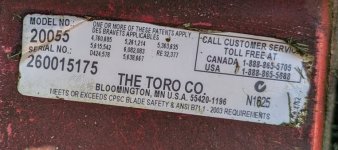
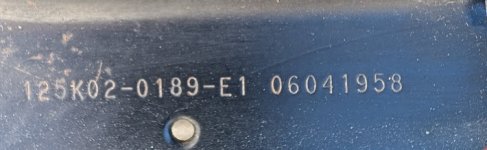
Briggs engine 125K02-0189-E1 06041958
RE On a sidenote for Sable HD shocks etc.: 2004 Sable wagon - the wagon rears are A-Arm and coil spring, whereas the sedans (which we do not have) are strut rears. Got the Mevotech springs and a set of KYB shocks, and old stock Moog ball joints. Mevotech springs too for the front along with new KYB Struts, KYB bearing plates, top spring plates, and lower rubber isolators to build them. All the Moog and Ford stuff for it are NLA, or 20 years old from sitting on a shelf, and the gas has leaked out of the shocks/struts. I sent back maybe 3 sets of old stock Monroe heavy duty shocks and struts that were degraded to junk status. Lost a ton of time trying to find them, and some money fighting with both Parts Geek and Rock Auto over some of the parts that had to be returned. Both sellers use AI to arrange returns, and have no customer service phone numbers anymore. It was an awful experience. I had to dispute the sales with Visa, and e-mail their CEO's to get a refund on some of the bad parts. Ebay stuff was easier to return when it arrived devoid of gas after sitting 15 - 20 years on a shelf. There were no shocks available that were firmer than KYB new production, and Mevotech was the only source for rear springs. They are made with wider variable OD steel but 1" shorter than the worn out original Ford Springs so they have a stiffer rate. However, the car sits maybe 5/8" higher in back compared to the old springs that had collapsed slowly over 22 years and 125,000 miles.
Toro 20055 260015175
Briggs engine 125K02-0189-E1 06041958
bolts go from the bottom of the deck into the case. They were a little loose but not really loose. The sound comes from the case. It is a cyclical raspy sound. I am thinking it is either the rings wearing in, or the coil gap is too tight and rubbing. I used the proper gauges to set it and torqued the coil and flywheel. Will have to pull the rewind starter to get in there and check. The unit has a flywheel brake, maybe it is rubbing. Still need the proper torque for the case to deck. I noticed when I turned the blade there is a spot where it makes a raspy sound like metal on metal but it comes from the area where the belt goes on it. Maybe the rewind starter up above?
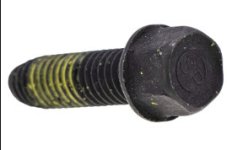
The mount bolts are black flange head (95-1727 Screw-Taptite). I don't see grade marks on them, just a circle with SP, but I am sure they will be harder than grade 2.
Here is what AI says about them.
The mount bolts are black flange head (95-1727 Screw-Taptite). I don't see grade marks on them, just a circle with SP, but I am sure they will be harder than grade 2.
Here is what AI says about them.
In the world of standard hardware, an unmarked head with a random "SP" circle defaults to a Grade 2 manufacturer mark. However, Taptite is a highly engineered, proprietary brand of trilobular thread-rolling fasteners heavily used by small engine manufacturers (like Briggs & Stratton, Kohler, and Toro)
When it comes to a genuine Taptite fastener, the markings mean something completely different:
The Real Strength: Grade 8 / Class 10.9 Equivalent
- The "SP" stands for Short Point: It is not a manufacturer's mark. The Taptite 2000® SP (Short Point) design is engineered specifically for shallow, blind holes in engine blocks to maximize full thread engagement without bottoming out. [1]
- The "No Radial Lines" rule doesn't apply: Thread-rolling screws follow completely different engineering standards than standard SAE hex bolts. They don't use the traditional 3 or 6 radial slash lines to show grade. [1, 2, 3]
Because these screws have to forcefully roll their own threads into a solid metal engine casting without snapping, they are incredibly strong. [1, 2]
Taptite screws used for structural components like engine mounts utilize a proprietary heat treatment process called CORFLEX®-I. [1]
- The Core: The body of the screw is neutral-hardened to a Grade 8 (or Metric Class 10.9) structural strength level. This gives it immense tensile strength and high resistance to the brutal vibrations of a lawn mower engine. [1]
- The Threads: The very tip and thread-forming zone are selectively induction-hardened to be even harder than the engine block, allowing it to cut the threads seamlessly upon factory installation. [1]
Last edited:
No one has answered with a spec, so I will use the Google AI suggestion of 25 ft lbs with blue Loctite. What I missed when mounting the engine is that part of the torque was getting the bolts to self tap into the aluminum. I did not get a true torque reading so the clamping force was low.
I bought a new rewind starter for it. Part of the noise is coming from it. The old one has 22 years on it. Will post the results of my recheck.
engine mount bolt/screw uses 3
I bought a new rewind starter for it. Part of the noise is coming from it. The old one has 22 years on it. Will post the results of my recheck.
engine mount bolt/screw uses 3
Looked through all my Toro material and can find no torque for mounting bolts. When I have bolts which are loose, I normally run a grade 5 through bolt and either a Nyloc nut or nut and lock washer. Torque to about 30 ft lbs.
Thank you. For now I am licking wounds.
Changed the rewind starter and that got rid of one noise. Tightened the bottom bolts to one and a half ommph, (will loctite and torque tomorrow) and another noise diminished. Checked flywheel - tight. Checked the coil gap in case the flywheel was rubbing on the coil.One side was under .006' so it moved since it was built. Used a Tecumseh air gap gauge to set air gap even though Tecumseh uses a couple thousands more than Briggs. That got rid of another light scraping in there. (the coil bolts were torqued originally to the spec so something moved). Now I had clarity on the only noise left. I already had an idea what it would be before starting it because I, unlike my other half, actually do check the oil when I say I do.
"I will accept everyone's, what a bummer man. All that work to built a perfect mower engine."
The other half insists on going outdoors and mowing the yard. She got in the habit while I was recovering from heart surgery 14 months ago. She gets angry when I do the lawns. First thing I ask her when she asks for help because she has flooded it, did you check the oil? She says yes. The dipstick and amount that came out today said no unless she had a cloud around her mowing yesterday - which I did not see. There is no glitter in the oil that came out, just fine color which is the cylinder and rings mating, which is good, but the noise that is left is piston slap that was not there when I built it and ran it the first couple times after building it. The slap is new from the last time she mowed the other day when it sounded terrible. The oil was off the bottom of the dipstick. The noise left now is clearly piston slap. Worse on cold start and as it warms up it goes away. It slaps worse than the engine that I rebuilt. I can only hope the cylinder is not damaged. Will borescope it tomorrow. Getting dark now and the skeeters are coming out for me.
For the record, In my early 30's I machined and built engines for a well known engine builder, a mentor who is now gone. Soon it will be my turn. I also built racing engines, suspensions, cars back at the same time. Just hate having my name on anything that is less that 100%. The slap won't keep it from running and mowing, just won't sound like a well tuned sewing machine anymore. Slap means the piston and bore are not properly sized for one another. Borescope will tell all. It also occurred to me that the wrist pin is tighter than worn so it may have been grabbing some without enough splash. That would certainly add to slap.
Last edited: