Shop tricks and tips

Freezing shrinks parts that go inside another part and heat (think kitchen oven at 350-400 and wear gloves) expands parts that go over another part.

Personally, since I have an air compressor and an impact wrench I prefer to use it for many disassembly jobs if the parts have been together for awhile. Just saves effort and reduces the chances of rounding off the heads. Clean before reaasembly, add lube/antiseize as dictated and use hand tools to tighten. I've used the impact wrench to remove a vacuum cleaner impeller nut and a well pump impeller nut rather than try to jam/lock the motor shaft.

An impact wrench is almost cheating! I LOVE 'em.:biggrin: Sometimes if I've got a stubborn fastener I'll actually try tightening before loosening...anything to get those molecules to break loose. Heat, of course, can help sometimes and places too.:thumbsup:
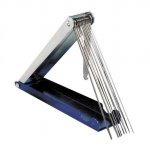
 
A welding tip cleaner set is great for cleaing out the small passages in carb jets and other areas in carb even after they are soaked, there is about 15 different sizes and they are stiff enough that you don't have a problem with them bending , Just bought a new on today at lowes for $5 after 15-20 use on the old one,
 

Attachments

  • welding_tip_acetylene_cleaner.jpg
    welding_tip_acetylene_cleaner.jpg
    29.9 KB · Views: 28
A welding tip cleaner set is great for cleaing out the small passages in carb jets and other areas in carb even after they are soaked, there is about 15 different sizes and they are stiff enough that you don't have a problem with them bending , Just bought a new on today at lowes for $5 after 15-20 use on the old one,

Another great cleaning, uh, tip!:ashamed::biggrin:Thanks!
 
Another --simple, common sence tip that many already know. Sometimes you don't have a tap drill chart or a large assortment of drill bits. To determine the "tap drill" size for any hole to be tapped--simply find a nut the same size and find a drill bit that will go through the nut with the least amount of clearance:thumbsup:
This is especially useful for small screws:thumbsup:
 
If you're rebuilding a carb or other piece that has many small parts to it, I'll usually scrunch up a shop rag or two when I start taking it apart. The folds in the shop rag, laying on the bench, do a good job of keeping small parts from rolling off, never to be seen again.:eek::mad::wink:
 
I had never heard of Fluid Film before either but after a few Google searches and some reading up on it, sounds like really great stuff. Thanks Sam.
 
When I''m out buying or getting old mowers for fixing up, one of the first places I'll check is the condition of the engine, (if it has one) I'll see if I can manually turn it, and feel for compression. If it has none , that's one thing, if it turns smoothly and then fetches up hard inside I'll spin it the other way. If it hits hard again, it's usually an indication of a thrown rod, which brings my offer WAY down. A seized engine can usually be loosened up with a little bit of ATF, PB Blaster and Seafoam, let it sit, and then a breaker bar with a 6 point socket on the crankshaft nut. I recommend against using an impact wrench to do this task. Please don't ask how I came to discover this...:ashamed::frown::biggrin:
 
A seized engine can usually be loosened up with a little bit of ATF, PB Blaster and Seafoam, let it sit, and then a breaker bar with a 6 point socket on the crankshaft nut. I recommend against using an impact wrench to do this task.

Interesting.. Sounds pretty tedious. How on earth did you come to discovering this?? :wink:
 
Back
Top