
You are using an out of date browser. It may not display this or other websites correctly.
You should upgrade or use an alternative browser.
You should upgrade or use an alternative browser.
Quackgrass killer that will not harm iris?
- Thread starter JDgreen
- Start date

RobertBrown
Lawn Addict
UNDERSTAND YOUR ENEMY
I can sympathsize with someone wanting to control one plant while not killing another. I have also noticed that there is a distinct lack of weed control information on this website and I've found it surprising. I began to think I'm one of the few that either has weeds or bothers to try and control them.
Having said that I, decided to try and help with your dilema, even though I have never ever heard of quackgrass.
A very brief internet search revealed that your weed reproduces using rhizomes. Which means that the important parts are underground (bad news for you). This fact makes conventional or contact herbicides effectively inefficient. This means that trying to kill quackgrass with a non selective herbicide (your only option), while not killing the other, more desirable plant, iris, is currently beyond the realm of possibilty.
Have a look at this and see if you don't agree. You have a really tough weed there my friend. looks a lot like an aquatic invasive that we have here known as "torpedo grass".
http://www.extension.umn.edu/yardandgarden/ygbriefs/h507quackgrass.html
I can sympathsize with someone wanting to control one plant while not killing another. I have also noticed that there is a distinct lack of weed control information on this website and I've found it surprising. I began to think I'm one of the few that either has weeds or bothers to try and control them.
Having said that I, decided to try and help with your dilema, even though I have never ever heard of quackgrass.
A very brief internet search revealed that your weed reproduces using rhizomes. Which means that the important parts are underground (bad news for you). This fact makes conventional or contact herbicides effectively inefficient. This means that trying to kill quackgrass with a non selective herbicide (your only option), while not killing the other, more desirable plant, iris, is currently beyond the realm of possibilty.
Rhizomes (underground stems) are yellow to white, 1/8" in diameter, with distinct joints or nodes every inch or so. Each node is capable of producing fibrous roots, and sending a new blade of grass through the soil. The creeping rhizomes are so tough they can grow through a potato tuber, or push up through asphalt pavement. If left to grow, they will form a dense mat 4" thick in the upper part of the soil. One plant can produce 300 feet of rhizomes each year. Never use a rototiller where quackgrass is growing, because it amounts to propagating thousands of new plants from the chopped up rhizomes.
Have a look at this and see if you don't agree. You have a really tough weed there my friend. looks a lot like an aquatic invasive that we have here known as "torpedo grass".
http://www.extension.umn.edu/yardandgarden/ygbriefs/h507quackgrass.html

JDgreen
Lawn Addict
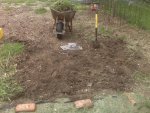
I am aware of how quackgrass grows and multiplies, and thank you for informing all of us. When I started my garden plot back in '96, I removed the top layer of sod and shook off the loose dirt, then rototilled. The current garden is 28 feet by 60 feet, and because when I started and enlarged the plot, I removed ALL the green vegetation, therefore there is no quackgrass growing in the garden EXCEPT for the area I planted asparagus in ten years ago. The attachment shows just HOW MUCH QUACKGRASS there was to dig out of a 6 foot square area....the wheelbarrow in the background is FULL of that stuff. What a huge PIB....
Attachments
SeniorCitizen
Lawn Addict
-----------------------------------------------------------------------------------------------------------Does anyone know of a chemical that will kill quackgrass but not harm iris? I have several iris beds that are heavily overgrown with quackgrass and it's too much work to dig everything up and replant the iris. Done that several times already. Thanks.
Glyosphate will kill it and here is how it's done in your iris. After the iris begin to go south, mow them off at a high mower setting. When the grass regains some height place a container over the plants and then using a paint roller with a long reach handle apply the glyosphate. By rolling in two or more directions with the paint roller better contact is assured and is far superior to spraying while using less product. Any grass in close proximity to the iris that was covered with the container is to be dealt with after the initial application by directing it away from the iris and applying the glyphosate with a small brush or other suitable applicator.
JDgreen
Lawn Addict
-----------------------------------------------------------------------------------------------------------
Glyosphate will kill it and here is how it's done in your iris. After the iris begin to go south, mow them off at a high mower setting. When the grass regains some height place a container over the plants and then using a paint roller with a long reach handle apply the glyosphate. By rolling in two or more directions with the paint roller better contact is assured and is far superior to spraying while using less product. Any grass in close proximity to the iris that was covered with the container is to be dealt with after the initial application by directing it away from the iris and applying the glyphosate with a small brush or other suitable applicator.
I have never heard of using a paint roller to apply lawn care chemicals but will try your method later this year...thanks much for the information. I purchased a gallon of the TSC vegetation killer last week, they were selling 50% glyosphate vegetation killer for $60 a gallon. The price was steep but you can kill just about anything using only 1 ounce of the chemical per gallon of water which means I will get 128 gallons of solution for my sixty bucks.
SeniorCitizen
Lawn Addict
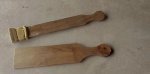
Another application method I use often, when close to other plants, is these two wooden shingle sections with one having the sponge applicator on both sides and the wider one being what I call the backer board. When the backer gets wet with the solution both sides of the leaf are coated when using the squeeze between the two boards method or the squeeze and drag down the limb method.:biggrin: More effective than spraying where 90 percent runs off of the leaf surface but sometimes I do resort to the sprayer.
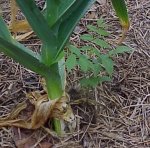
The small elm tree beside the garlic will get propped away from the garlic plant so it doesn't touch it and a half a teaspoon or less is all that will be required on this one. Depending on weather conditions this tree may take 2-3 weeks before results appear.
The small elm tree beside the garlic will get propped away from the garlic plant so it doesn't touch it and a half a teaspoon or less is all that will be required on this one. Depending on weather conditions this tree may take 2-3 weeks before results appear.
Attachments
Hi JD Green
Now my wife uses this spray that"s called (grass no more) i think that" what it"s called in her flowers garden and that works great and it only kills the grass but i think there is only lawn grass in her flower garden and i don"t know if it will work on quack grass go to a garden center and read or ask them if you can use it on iris they are flower so it should work. It comes in a jug all mixed and ready to use.:thumbsup:
Now my wife uses this spray that"s called (grass no more) i think that" what it"s called in her flowers garden and that works great and it only kills the grass but i think there is only lawn grass in her flower garden and i don"t know if it will work on quack grass go to a garden center and read or ask them if you can use it on iris they are flower so it should work. It comes in a jug all mixed and ready to use.:thumbsup: