I took this engine apart thinking the compression release was bad. turns out it was ok. put it all back together but the governor does not work or I screwed up something. If i push the governor arm forward to the front of the engine the rpm's will go down. does the governor control arm need to be setup again even if everything is the same in the engine and that linkage was not taken apart?

You are using an out of date browser. It may not display this or other websites correctly.
You should upgrade or use an alternative browser.
You should upgrade or use an alternative browser.
engine runs full out after 'rebuild' 287707 14.5 OHV
- Thread starter dakotamar
- Start date

Tiger Small Engine
Lawn Addict
Don’t run it like that or it will grenade pronto. Reset governor and when you start it, be ready to manually override the speed immediately.I took this engine apart thinking the compression release was bad. turns out it was ok. put it all back together but the governor does not work or I screwed up something. If i push the governor arm forward to the front of the engine the rpm's will go down. does the governor control arm need to be setup again even if everything is the same in the engine and that linkage was not taken apart?

sgkent
Lawn Addict
If the nut is loose so the arm can spin on the shaft, and you cannot spin the shaft in either direction, then something is jammed. Keep in mind that the engine ALWAYS tries to run at full throttle with the butterfly wide open. The job of the governor is to not allow that, and pull it back to a reasonable speed. To adjust it, the throttle is held full open, and the governor pulled back to its stop. Then it can move in the direction that closes the throttle a little when it is running. On mine, the movement of the governor might have been 1/4". Not a lot. I think a 1/16" socket fits on top of the governor shaft which makes it easy to turn and hold it in position while the arm is tightened. Whatever way the governor pulls the throttle to slow it, you want the shaft to rotate the opposite direction to its stop. That way it has maximum movement to close the throttle. If you do it backwards, then it has no way to turn to close the throttle.
sgkent
Lawn Addict
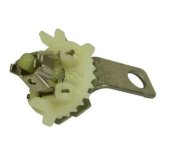
can't say mine moves much more (and its new since I remanufactured my 20 year old Toro with a Briggs and Stratton engine a couple weeks ago) . You need to adjust it properly and see if the problem goes away. The uses that governed engine have don't usually require a variable speed so it doesn't need to move very far. Inside the engine is this part. Notice how short the nose is that moves when the shaft turns the paddle (which leverages the small motion on the shaft.) There is a photo of that too. That little bit of movement on yours moves the paddle arm quite a bit. Although, the reverse is really true. The oil slinger governor moving the paddle quite a bit only turns the shaft a little. 15 degrees isn't much on a shaft, but out at the end of the paddle that is quite a distance. It is also quite a distance out at the end of the arm the linkage attaches to.

Last edited:
ok, so i got thinking, maybe i can't turn that shaft well enough with plyers. so i put the socket on it and yes there was play to adjust. adjusted the position and now I can use the throttle to lower the rpm. engine is running better. I have to pick up a tach as it is still running a bit fast at top end (by ear), or so it seems. thanks again for you input sgkent.
Just couple hints:
Do a static governor adjust.
Make sure the throttle CABLE is located proper under the cable clamp so as to get a choke and return to low rpms when the throttle on the dash is moved to idle.
Sometimes and this takes a bit of trial and error: Because the governor shaft only moves about 1/4 turn from low to high control.
You can do the static governor adjust but instead of holding the governor arm all the way in same direction as the full open carb, back the governor shaft off in opposite direction just a bit. If you take it back too far the engine won't reach full High rpms at full throttle. The governor is holding down the high rpms.
Think of this as adjusting the static governor adjust backwards or opposite the norm which makes the governor hold the engine at low rpm
This opposite static governor adjust is also a good way to troubleshoot a governor control if it appears the governor is not operational when doing the norm the static governor adjust method..
If the mechanical governor is not broken inside the engine the governor should hold the engine at a lower rpm.
Summary: Sometimes doing the static governor adjust by the book will cause a engine rpm to be too high.
Do a static governor adjust.
Make sure the throttle CABLE is located proper under the cable clamp so as to get a choke and return to low rpms when the throttle on the dash is moved to idle.
Sometimes and this takes a bit of trial and error: Because the governor shaft only moves about 1/4 turn from low to high control.
You can do the static governor adjust but instead of holding the governor arm all the way in same direction as the full open carb, back the governor shaft off in opposite direction just a bit. If you take it back too far the engine won't reach full High rpms at full throttle. The governor is holding down the high rpms.
Think of this as adjusting the static governor adjust backwards or opposite the norm which makes the governor hold the engine at low rpm
This opposite static governor adjust is also a good way to troubleshoot a governor control if it appears the governor is not operational when doing the norm the static governor adjust method..
If the mechanical governor is not broken inside the engine the governor should hold the engine at a lower rpm.
Summary: Sometimes doing the static governor adjust by the book will cause a engine rpm to be too high.
Last edited: