Briggs 422707 opposed twin carb

Hello C.,

"Nothing ventured nothing gained" is a saying that seems to fit when no one can provide a direct answer. I suspect many people have either lived with the running issue or gave up.

Aftermarket carburetors are a luck of the draw, and many have gotten better over the years, but they are still not a perfect solution as a bolt on and go option.
T
Drilling the extra hole will just line up with the extra bowl vent and that is no harm. It may provide some kind of "atmospheric balance" that only a well-trained carburetor engineer would be able to explain.

I've dealt with many automotive and small engine carburetors over the years, and I know they all require an ideal fuel/air "balance" to function efficiently.
Where would we be if we never tried something that may have worked !
Just wish they made carbs for these engines with the mixture screw?
They do for the single cylinders?
Anyway thank you gor all the input
I picked up a nice opposed engine yesterday and looks like may be a good runner for another project it was in an old mower was going to check out the carb on it but there was a big wasp nest in it!!
Loaded this thing in my truck and unloaded opened hood several times on that mower don't know how they didn't attack me!!
So will look and see what carb it has on It today!
I have time to drill the hole will be after I have exhausted other options!
Thanks Doc
 
Hello C.,

(More thoughts)

From my automotive training many years ago, one thing that has stuck with me is the ideal fuel to air ratio number of 14.7 parts air to 1 part fuel. If enough air cannot get in the fuel bowl as the engine is demanding the fuel, a cavitation effect can take place.

The jet size and the carburetor air venturi have to constantly meter/control the fuel/air mixture.

If you do pull the top off the carburetor, check the fuel float level adjustment, because a poor float adjustment can contribute to this issue as well.
 
Hello C.,

(More thoughts)

From my automotive training many years ago, one thing that has stuck with me is the ideal fuel to air ratio number of 14.7 parts air to 1 part fuel. If enough air cannot get in the fuel bowl as the engine is demanding the fuel, a cavitation effect can take place.

The jet size and the carburetor air venturi have to constantly meter/control the fuel/air mixture.

If you do pull the top off the carburetor, check the fuel float level adjustment, because a poor float adjustment can contribute to this issue as well.
That is iinteresting now that I think of it seems like its a little wet with fuel inside air cleaner with the China 4 screw !
Could be a float deal so another?????
 
Hello C.,

(More thoughts)

From my automotive training many years ago, one thing that has stuck with me is the ideal fuel to air ratio number of 14.7 parts air to 1 part fuel. If enough air cannot get in the fuel bowl as the engine is demanding the fuel, a cavitation effect can take place.

The jet size and the carburetor air venturi have to constantly meter/control the fuel/air mixture.

If you do pull the top off the carburetor, check the fuel float level adjustment, because a poor float adjustment can contribute to this issue as well.
Doc you really got me thinking and I got the 3 screw original carburetor that I have gone through several times not understanding why it wasn't working??
Air/fuel ratios and how all the vents jets work
I had gone through everything many times!!
Then looking at the main gasket that separates the carb body lining up the holes ect!
Then I discovered it!!
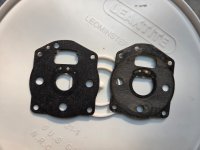
The ^#***#!*^ ORIGINAL owner had the wrong gasket in there??
Luckily I have a bunch of gaskets and had the right one!
So problem solved and engine runs great!
Guess it was all worth it and learned alot along the way!!
But still wondering about the 4 screw carb and the extra hole??
Anyway
Thanks so much!
And a couple pics of the two gaskets the correct one on the right!
 

Attachments

  • 20260805_175845.jpg
    20260805_175845.jpg
    1.2 MB · Views: 13
Hello C.,

Glad you got it figured out.

This is the way many things get resolved if you have the determination to see a problem through to a solution. I've been a technician for 40+ years, and I still call on fellow techs when I get stumped.
 
I see in one of your posts that you wished the carb for them had adjustable jets.

Some do. I have some that have one adjustment jet.
Some can be very critical (1/8 turn) for good idle from cold to hot engine.

I have several in operation that are the non-adjustable and they work good, but every once in awhile I get a non-adjustable that just won't come around even after using the U sonic.. I keep them for parts. I've bypassed the fuel pump on some of the opposed twin carbs and just use the more user friendly pulse pump. If you look you can drill and tap the front of the carb with 1/8 inch hose barb for the bypass.
 
I see in one of your posts that you wished the carb for them had adjustable jets.

Some do. I have some that have one adjustment jet.
Some can be very critical (1/8 turn) for good idle from cold to hot engine.

I have several in operation that are the non-adjustable and they work good, but every once in awhile I get a non-adjustable that just won't come around even after using the U sonic.. I keep them for parts. I've bypassed the fuel pump on some of the opposed twin carbs and just use the more user friendly pulse pump. If you look you can drill and tap the front of the carb with 1/8 inch hose barb for the bypass.
The Carb that I got working is the adjustable carb!
Thanks
 
Good!

To get the best performance, adjust the screw with the throttle on high. slowly adjust the mixture screw to get the best rpm out of the engine. To go one step further, move the throttle level with your finger a little farther and see if the mixture is still good or needs to be dialed in just a little. Do not push it at high RPM for any longer than necessary. The extra "tweaking" ensures the governor can really kick it up under extreme load conditions if needed.

These engines really show their true power when they are "dialed in"
 
Good!

To get the best performance, adjust the screw with the throttle on high. slowly adjust the mixture screw to get the best rpm out of the engine. To go one step further, move the throttle level with your finger a little farther and see if the mixture is still good or needs to be dialed in just a little. Do not push it at high RPM for any longer than necessary. The extra "tweaking" ensures the governor can really kick it up under extreme load conditions if needed.

These engines really show their true power when they are "dialed in"
That's my next step started today but found air leak between carb and riser so off it will go again for a new gaskets!
I have 2 other mowers OHV'S I have been working on that are tough to seal the Opposed is much easier!
Im close!
 
Back
Top