2000 Kohler 15.5hp valve gap adjustments

Research seems to indicate these CV models used hydraulic lifters and are self adjusting. Having changed oil and filters regularly and leaving the valves alone for 26 years may be why they still work.

On the issue of adjustment, maybe “If it ain’t broke, don’t fix it” applies here.

Apparently the hydraulic lifters are for lower rpm engines on cheaper mowers (likely used where little or no maintenance by low tech users is expected.)

This engine starts easily, runs fine, and does nothing stupid.

Various forum thread attempts to service hydraulic lifters seems to induce more problems than ever solved, usually ending in arguments over how to do it.

All the other to do’s are noted especially cleaning.

(No clue what a JD or SAM box is.)

(Item #11 in Post 3 not applicable in WUMC suburbia.)

As much as asking AI irritates, perhaps it is simpler. And seems to not tell the asker, “You are a dumb butt” for asking.

View attachment 73162
You definitely don't know Kohler engines. The Kohler command has always used hydraulic lifters and the same style lifters used on auto engines to this day. And they were not used on lower end mowers. The Command is considered the flagship engine and they were used on lower end mowers because that was the only engine that Kohler offered. The K-series and the magnum series were being phased out. The Courage series was Kohlers first attempt at consumer grade engines. Up until that time Kohler engines were not really designed for the consumer market.

JD means John Deere and SAM is Spark advance module, Which was the first 2 advances in spark advance ignition. You had the ASAM which was analog and the DSAM which was Digitial spark advancement. I have never seen a SAM on a CV15. The SAM was used on the CV16. And the Command CV15.5 was actually a lie told by Craftsman that started the HP lawsuit.

Sears mower says 15.5 but from your previous post the engine clearly is marked CV15 which Kohler rated at 15 not 15.5. Sears would use a different enigne rating system than other companies so they could use a different HP rating on their mowers than what the engine manufacture used to rate their engines.
 
Research seems to indicate these CV models used hydraulic lifters and are self adjusting. Having changed oil and filters regularly and leaving the valves alone for 26 years may be why they still work.

On the issue of adjustment, maybe “If it ain’t broke, don’t fix it” applies here.

Apparently the hydraulic lifters are for lower rpm engines on cheaper mowers (likely used where little or no maintenance by low tech users is expected.)

This engine starts easily, runs fine, and does nothing stupid.

Various forum thread attempts to service hydraulic lifters seems to induce more problems than ever solved, usually ending in arguments over how to do it.

All the other to do’s are noted especially cleaning.

(No clue what a JD or SAM box is.)

(Item #11 in Post 3 not applicable in WUMC suburbia.)

As much as asking AI irritates, perhaps it is simpler. And seems to not tell the asker, “You are a dumb butt” for asking.

View attachment 73162
 
THANK YOU to hlw49 from whom I caught enough specific information to ask AI a better lifter question telling me essentially, confirming hlw49, there no need to fix what isn’t broken.

I had learned how to adjust a mower with Briggs Craftsman valves. Just figured was Kohler the same idea.

I never had the slightest idea a small engine had auto type hydraulic lifters. No wonder it is still running.

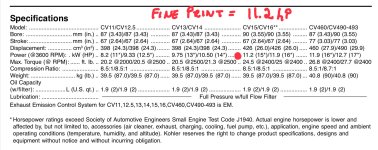
As to horsepower, this 2000 Craftsman Kohler 15.0hp (not 15.5), a 2007 Craftsman Briggs 20hp, and a 2014 Craftsman Briggs 19hp, at different houses, all mowed the same grass in the same way with the same 42” decks. The hp mattered not at all. What did matter was sharp proper high lift blades that the decks all liked. Cut, blow out the side to disperse, mulching is silly, bagging is stu-pid.

(+/-) 0.5hp could never make a difference. Just lawyers at work. The manual seems quite clear:
IMG_1281.jpeg

The real limit was/is the poor air handling nature of the 42” decks. If the grass was damp, they all blew clumps collecting somewhere and then blowing out. This even with the discharge chutes shortened and blocked vertical. Cheap, poor, industry wide, one maker design.

Having way better mowers today, its easy to see how poor the deck design was and still is. MTD, TroyBuilt, Bolens, CubCadet, Craftsman, YardMan, all the same cheap consumer stuff. The color of the paint is the cost differential. 🤓
 
Last edited:
A note for the fellows helping an old guy. SLOMO, ILENGINE, and HLW49. Thank you for your posts and information. It is appreciated. Casual users are not always “smart” enough to understand or pay attention, but some feed back is appropriate.

The 19hp 2014 B&S Craftsman engine noted in another thread with the trolling motor battery mod was interesting. It has very little air handling metal shielding around any of the aluminum block cooling fins. The fins are plainly visible from all angles almost everywhere by bright flashlight. Looking at it carefully, there was nothing to clean that would not reappear in another hour of use.

BUT, the 15.5hp (15.0) 2000 Kohler Craftsman engine in this thread was the complete opposite. It has metal shielding for air flow handling around almost every bit of the engine head cooling fins. Nothing much is visible no matter where you look.

After replacing the worn out brake pads and knowing there is no need to fiddle with the Kohler hydraulic valve lifters, I took all the metal shielding off the block. One needs to take pictures and keep track of which bolt goes where since there are three sizes, several lengths, two SAE, and one 10mm metric.

The fins, ALL of them, with the shielding OFF, were nearly invisible from collected hardened dirt and oil vapor or some such. Filled/packed completely up to the shielding.

Brushing was useless. Compressed air was useless. Picking with a screwdriver was not sensible. A 2500psi water pressure washer cut the stuff away everywhere down to shinny aluminum. Very shinny.

Reassembly was just selecting little bolts as noted.

Threw in a new spark plug and away it went.

Credit where it’s due. Known problems solved and probably way worse prevented. Thank you.

It isn’t just 26 versus 12 years. The one design is a dirt trap. The other not so.
 
Last edited:
Thank you Sears L2000 for your kind words. We need more people like you that recognize the people that helped them. They just run off and never respond back. But you know what you told them was the cure for their problem because that is the last time, they reacted to the post. Thanks again!!!!!!!
 
Back
Top