.010 oversize piston???

i have a 1985 3hp briggs and stratton snapper and it recently started burning oil. i opened up the engine to find a large gash in the piston and a badly scratched up bore. now i ordered a .010 oversized piston but im not to sure how im supposed to widen the bore to fit the new piston. do i just use a hone of some sort? or do i have to take it to a machine shop???
 
machine shop. A DIY would never be able to keep the bore straight or the correct clearances. If no one wants to do it, take a look around for people who go cart race. They will know who is set up for it. Might want to have them check the valve guides while you are in there.
 
Well another DIYer just throwing parts at a problem before knowing what the actual cause is.

You must have the correct tools. For cylinder resizing if needed it is a ridge hone, a 1/2" high torque drill, and a good pair of calipers. Just ordering a piston before knowing how bad a cylinder worn can be expensive as might require a larger size or have a cylinder that is worn beyond any available oversize piston and rings.

Plus these old L head engines tends to smoke when the exhaust valve guide is worn out. Intake guides seldom fails. Many users assumes the worst like a blown head gasket or rings. Again you must have the correct reaming tools and drivers to install a replacement valve guide if you can even get a replacement guide. Several about ten years ago were going NLA and I had resort to making my own guides out of brass tubes. Also there is more than one style of replacement guides that were once available for these engines depending the model and type numbers. One was even a cast bushing valve guide.

The lesson here is; unless, you know exactly what you are doing and the right tools you are just wasting your money throwing parts at it and hoping you have guessed right.

I got a customer that just tried to repair his mower after he insisted on an electric fuel. The cheap Chinese pump failed. During his attempt to find the problem he nicked the wire going to pump even I installed bullet connector that simply needed to be separated for testing the pump. Now it is in the shop and he said smoke was going out the debris screen. I did order a stator and voltage regulator without checking as he might have fried both coils. But being a shop I can always sale it later to someone else.

Kinda pissed me off he did this releasing of the magic smoke. Now I got figure exactly what he shorted out and how. I think without actually testing he grounded the stator and regulator because smoked the engine turning on the ignition switch.

As the old saying goes "A fool and his money are soon parted." can ring true at times. What worst is Brian just voided his repair warranty. It may have cost only the additional parts now labor is back in the mix.
 
when a cylinder is honed to an oversize, it is not just the steel that wears away. The stone wears too as the cylinder is honed. There is an optimal overstroke on the honing that has to be maintained to keep the stones wearing even. If the stroking of the hone is not proper (which is probably impossible without the right equipment), the cylinder will have a taper in it, or might end up like an hourglass. That will cause two problems, (1) the clearance between the cylinder and piston will also vary so it will be from too loose to too tight. (2) The rings will work open and close as the piston goes up and down thru that taper or hourglass. That will wear the ring lands very quickly and eventually wear the rings away or break them. It might not burn oil, and have lots of power leaving the shop, but it will die much sooner than one expects.

When I did this for a living, boring engine blocks and racing blocks daily, the hone had a very sensitive amp meter on it. As the stones move thru the cylinder, and the cylinder size varys, the meter will show the variance in the current the honing system is drawning. It will draw more as the cylinder gets tighter and vs versa. I would vary the stroke length, and placement in the stroke length to keep the cylinder straight. The clearances we are dealing with here are very small. So I would not hone a cylinder oversize by hand, ever. The cylinder walls will never be as straight as they need to be. That said, the cylinders on throwaway aircooled mower engines flex more than a car. One has to take that into consideration too because the hone will just ballon the cylinder as it passed by the weak spots, instead of cutting.

here is a Youtube of a Sunnen CK10 taking a cylinder oversize.

 
i have a 1985 3hp briggs and stratton snapper and it recently started burning oil. i opened up the engine to find a large gash in the piston and a badly scratched up bore. now i ordered a .010 oversized piston but im not to sure how im supposed to widen the bore to fit the new piston. do i just use a hone of some sort? or do i have to take it to a machine shop???
Why would you do a partial rebuild on a 40 year old 3 horsepower engine? It ain’t worth anything really.
 
I recommend a used engine block with minimal wear at the very least. There are a lot of these old 3HP and 3.5HP engine laying around and for sale on eBay.
 
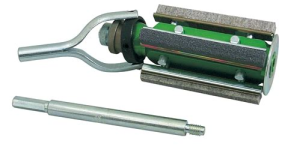
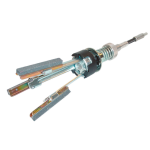
Here is the difference between a cylinder hone and a glaze breaker. The hone is used to enlarge cylinders and keep the bore reasonably straight. The glaze breaker is used to remove the glaze (smooth surface) from the cylinder. Often people refer to a glaze breaker as a hone as you can see the glaze breaker has no way of assuring a straight cylinder.

Lisle Engine Cylinder Hone - 15000​

SKU #1813243
$283.99

1783776893246.png


Lisle 23500 Adjustable Engine Cylinder Glaze Breaker 2 to 7 Inch Range

1783777175650.png
 
i have a 1985 3hp briggs and stratton snapper and it recently started burning oil. i opened up the engine to find a large gash in the piston and a badly scratched up bore. now i ordered a .010 oversized piston but im not to sure how im supposed to widen the bore to fit the new piston. do i just use a hone of some sort? or do i have to take it to a machine shop???
Machine shop....
 
when a cylinder is honed to an oversize, it is not just the steel that wears away. The stone wears too as the cylinder is honed. There is an optimal overstroke on the honing that has to be maintained to keep the stones wearing even. If the stroking of the hone is not proper (which is probably impossible without the right equipment), the cylinder will have a taper in it, or might end up like an hourglass. That will cause two problems, (1) the clearance between the cylinder and piston will also vary so it will be from too loose to too tight. (2) The rings will work open and close as the piston goes up and down thru that taper or hourglass. That will wear the ring lands very quickly and eventually wear the rings away or break them. It might not burn oil, and have lots of power leaving the shop, but it will die much sooner than one expects.

When I did this for a living, boring engine blocks and racing blocks daily, the hone had a very sensitive amp meter on it. As the stones move thru the cylinder, and the cylinder size varys, the meter will show the variance in the current the honing system is drawning. It will draw more as the cylinder gets tighter and vs versa. I would vary the stroke length, and placement in the stroke length to keep the cylinder straight. The clearances we are dealing with here are very small. So I would not hone a cylinder oversize by hand, ever. The cylinder walls will never be as straight as they need to be. That said, the cylinders on throwaway aircooled mower engines flex more than a car. One has to take that into consideration too because the hone will just ballon the cylinder as it passed by the weak spots, instead of cutting.

here is a Youtube of a Sunnen CK10 taking a cylinder oversize.

Damn good advice....
 
Machine shop probably about $150, a little cheaper if you do the finish honing. It can be done with a Lisle rigid hone, and I've done it on more than a few Tecumseh engines, V-twin inteks, and even a Vanguard V-twin. Its a long day its alot of work and you need the tools to make it straight or within .001" those tools cost money more then the machine shop and if its your first attempt and your not gonna do it agian its probably not worth doing it yourself. your other option is a cheap finish hone "deglazer" forget the piston take your .010 rings put them on the orginal piston and finish hone the crap out of it till you get somewhat close to getting rid of the score mark (probably wont happen.) your going to have to file the rings to fit and to get your end gap. Ive done this many times, but it requires some know-how and again some tools. and on an engine like that, you're probably pulling more oil through the valve guides then the bore. its a small engine same rules apply to all engines but its not a race car deglaze the crap out of it put your .010 over rings on the original piston put it together and realize it was the guides pulling more oil then the bore or have a machine shop do it. I feel bad that there is no cheaper option that will work I also spent alot of money on tools and valve cutters valve refacers etc. I do use them I do make money with them but they have hardly paid for themselves. I also don't plan on selling them because any piece of junk I buy, from mowers to four wheelers Im gonna make run no matter what. I hope that helps in your decision-making.
 
Back
Top