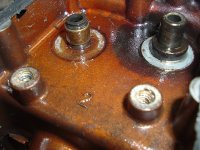
1996 B&S 15.5HP engine issue

31R907-0007 might be a possible replacement. Your original engine is supposed to supercede to the 31A607-3026, but that engine isn't showing in the briggs distribution system. and Briggs shows the replacement engine is the same as the original 31A607-3026 engine.
Thank you, I will check into this engine and check with a guy I used to work with who had a small home business, maybe he has some parts.

Any item on the plastic shim under the intake that broke apart? That is not showing on the exploded views I pull up online but I doubt it was ever replaced. We did all the work on it since new back in May 1996.
Seems like I remember some of the older engines having a Intake valve stem seal that was mushroom shaped. Could that plastic piece be part of the valve stem seal.
 
Seems like I remember some of the older engines having a Intake valve stem seal that was mushroom shaped. Could that plastic piece be part of the valve stem seal.
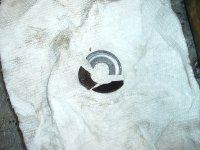
No, there was a positive seal on the valve guide, the one I am talking about was under the spring and steel seat, against the head. It is 021-022" thick, 1.155" OD and .465 ID, measurements are not exact since it broke into 3 pieces.
 

Attachments

  • 9 broken instake washer.JPG
    9 broken instake washer.JPG
    337.2 KB · Views: 3
  • 5 intake seal.JPG
    5 intake seal.JPG
    471.2 KB · Views: 3
No, there was a positive seal on the valve guide, the one I am talking about was under the spring and steel seat, against the head. It is 021-022" thick, 1.155" OD and .465 ID, measurements are not exact since it broke into 3 pieces.
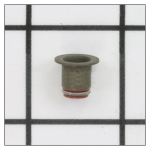
I was thinking something like this 1793747262947.png
 
I was thinking something like this View attachment 74920
Now that is interesting. The broken one doesn't look like it separated from the oil seal but I don't have a new one here to compare. It would make sense since it doesn't show up in the parts diagram. Thank you. I know it makes sense to toss the old tractor and go to a newer one but I am the type that likes to rebuild if I can, rather than replace. It's not always practical but I work on corvettes everyday which are certainly not practical.
 
Now that is interesting. The broken one doesn't look like it separated from the oil seal but I don't have a new one here to compare. It would make sense since it doesn't show up in the parts diagram. Thank you. I know it makes sense to toss the old tractor and go to a newer one but I am the type that likes to rebuild if I can, rather than replace. It's not always practical but I work on corvettes everyday which are certainly not practical.
The truth is, in this day and age, you are better off fixing the old stuff then buying the new stuff which will fail within a few short years.
 
I would locate a new updated head kit if possible and replace both push rods.

I have tried pinning the valve guides on my own stuff a couple of times and had some good results, but it is tedious and there is no telling when it will fail next. Teryl Fixes All on You Tube has a great video of how he does it.

He is a goofy character, but it plays into people impression of mechanics being stupid grease monkeys. In reality, the guy is a genius when it comes to small engine equipment.

Briggs and Stratton warrantied a lot of heads back when this problem began, then started making excuses and delaying many until the warranty period expired. Nothing has been built to truly last in the past 25 years due to engineered calculations known as predetermined failure rate.

This is how the number crunchers like it.... keeps them selling new equipment. (No, I'm not paranoid, that is just reality)

Edit: That broken washer is usually nylon and there to allow for valve spring cushioning, so the steel spring does not wear groove in the aluminum head. It is not vital, but it does have that job.
 
Last edited:
I would locate a new updated head kit if possible and replace both push rods.

I have tried pinning the valve guides on my own stuff a couple of times and had some good results, but it is tedious and there is no telling when it will fail next. Teryl Fixes All on You Tube has a great video of how he does it.

He is a goofy character, but it plays into people impression of mechanics being stupid grease monkeys. In reality, the guy is a genius when it comes to small engine equipment.

Briggs and Stratton warrantied a lot of heads back when this problem began, then started making excuses and delaying many until the warranty period expired. Nothing has been built to truly last in the past 25 years due to engineered calculations known as predetermined failure rate.

This is how the number crunchers like it.... keeps them selling new equipment. (No, I'm not paranoid, that is just reality)

Edit: That broken washer is usually nylon and there to allow for valve spring cushioning, so the steel spring does not wear groove in the aluminum head. It is not vital, but it does have that job.
Thank you Doc. Makes perfect sense on the shim and I can see it did have a little wear on it. McMaster Carr may have one similar.

I did see that repair on YT by Teryl and have seen a lot of his videos over the years. It seems as if others have also copied his idea as they are using the same procedure and 10-24 set screw, I may go to a 10/32 set screw. It is not a problem for me to do as I am setup with small machine shop for the vette diff's I build, so I should have everything here. I haven't put a straight edge on the head yet but I will, just to make sure it's not warped. I can set it up in the Bridgeport if needed but I think it may be ok. The head gasket was still good and one I replaced several years ago.
 
you can go to Briggsandstratton.com then look at new engines. They show the snout length and od in the specs. The bolt pattern shows in the photos. That would be one way of seeing what might work. Last summer I rebuild (I was a machinist and engine builder at one time so it is more like remanufactured), a 190cc 6+ horse L-head engine. It started with just going to re-ring it, but anytime these old engines are looked at one finds things that aren't so good. I found a pit and crack in the cylinder wall, so needed a new block. Might as well get a new piston and rod, and the next thing is it would have been less expensive just to buy a new engine - but here in California no one can sell you a new under 25 HP engine.
 
also, I have not worked on that engine. However they might have an oversize guide where you could use a valve guide reamer on it then put the guides in. If not, new guides might work where you peen the outside a little all around, not so much that it would be impossible to drive it in, or crack the guide. Then use green Loctite. Maybe pin it too if you want. If the head is a little warped you can throw it on a reasonably thick piece of glass with various grades of wet and dry. One sands and rotates so the pattern is not just one direction. That will take warp out. Most new guides have to be reamed after they are put in.
 
Back
Top