B&S Craftsman 2013 Platinum 540cc 19hp Compression Relief Failure Work Around

I have had similar 1999-2013 B&S engines fail due to the compression relief system breaking. Endemic apparently in Briggs engines and they do not care. One was junked since the mower was all worn out. One was rebuilt at expense. The subject engine here has been used for two years after failure by jump starting it with a car battery. The mower itself is in very good condition. Start, mow, put away, shut off because it will not usually crank to restart even hot on the little battery under the seat.

Thought up a simple concept for a work around better than jump starting and did it.

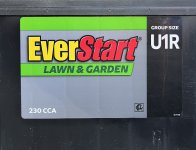
1). Remove the Lawn & Garden 12 volt 230CCA battery from under the seat and set aside.

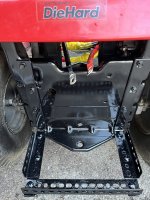
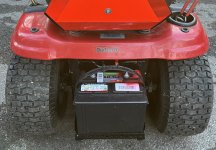
2). Fabricate a cradle/bracket for a real battery on the out side of the mower frame back plate below the seat level and between the back of the rear tires. Sits on the drawbar hole plate. There is no room internally for a large battery.

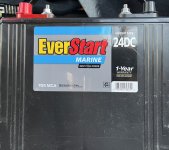
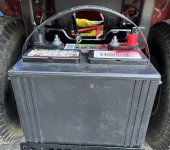
3). Put a Marine Deep Cycle Starting 12 volt 705MCA battery in the cradle. Used for its relatively small size, Walmart 24DC EverStart Marine, and large capacity, but the fishing trolling motor battery design dumps power slower than a pure engine starting battery.

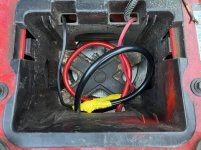
4). Extend the factory mower battery cables and connect to the trolling motor battery.

5). Spins and starts instantly and is the same battery I have been using to jump start the engine anyhow. This hasn’t hurt anything in two years, but works without jump starting because the battery now goes with the mower. With the cradle/brackets painted black, you have to look to see what the lump of battery is on the back plate.

I know it works just fine, but have a question.

Question: What effect on the engine starting system does using a large high capacity battery, mainly on the starter motor, have?
 
Last edited:
IMG_4143.jpegIMG_4148.jpegIMG_4144.jpegIMG_4145.jpegIMG_4146.jpegIMG_4147.jpegIMG_4149.jpeg
The original 2013 small battery was a Sears Die Hard Lawn & Garden which seems appropriate. The mower is sturdy. The engines are not. The plastic carry handle needs removed and terminals refastened.

As neat as I could make it to avoid being accused of Bubba and hopefully of Farm Boy Quality.😻
 
Last edited:
Let's see overheating the starter motor causing internal damages like shorted windings, overheating the starter relay [solenoid] burning contacts and melting internal plastic parts. But its your mower and your money. Actually just cheaper just to replace the camshaft. And even the 200amp starter relay is rated at 15% duty cycle.

Now the camshaft ACR on the 793880 camshafts are a very poor design.
 
Logical and no argument. As a practical matter, if it’s not useable in a cost free manner such as this, it junk yard time. Been doing the same thing WITH the small battery in place. Figured taking the small one out reduced the available load to just the large battery.

As an aside, the engine fuel and ignition system is 100% GTG. It cranks faster and starts faster without the longer cranking time of the small battery. Starts immediately at 20F, 10W40.

Key on, start, unload system quickly. I was hoping that reduced damage potential. But since been doing it for two seasons anyhow.???
 
Last edited:
The actual problem with evaluating this issue, besides quick guru surface guesses, is that the normal current draw varies greatly.

In a tuned valve adjusted GTG engine with a fully charged battery, the electric starter should draw in the area of 100-200 amps.

If fuel, tuning, ignition, valve adjustment, battery charge, etc., are not spot on, the draw raises to the 300 amp range. Making the cranking cycle longer and with a slower spin speed does not protect starting components. It compromises them.

The larger twin cylinder engines may hit 500 amps with their starters.

A large fully charged battery offers full current longer with no instant slow down normal from a small battery capacity. The big battery capacity results in a quick spin and a quick start literally in a pop going by the broken compression relief point.

Without an actual amp meter test, I am not so sure the big battery quick start is any harder on the engine starting system than a small battery needing more time to crank. And a weak small battery will zap itself and the starting system.
 
The actual problem with evaluating this issue, besides quick guru surface guesses, is that the normal current draw varies greatly.

In a tuned valve adjusted GTG engine with a fully charged battery, the electric starter should draw in the area of 100-200 amps.

If fuel, tuning, ignition, valve adjustment, battery charge, etc., are not spot on, the draw raises to the 300 amp range. Making the cranking cycle longer and with a slower spin speed does not protect starting components. It compromises them.

The larger twin cylinder engines may hit 500 amps with their starters.

A large fully charged battery offers full current longer with no instant slow down normal from a small battery capacity. The big battery capacity results in a quick spin and a quick start literally in a pop going by the broken compression relief point.

Without an actual amp meter test, I am not so sure the big battery quick start is any harder on the engine starting system than a small battery needing more time to crank. And a weak small battery will zap itself and the starting system.
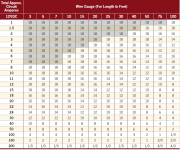
You need to drop a zero at the end of your amp figures. A 3 foot long cable that supports 200 amps is a 1/0 gauge cable. Most mowers have what 8-10 gauge wires to the starter? No doubt all are in serious voltage drop land.

1772477134784.png
 
(1). Interested in a professional opinion, I consulted at length with an electrical component design engineer for a multi national company.

His opinion was that the starter would attempt to draw the same amperage from either the OEM style Lawn & Garden 230CCA, OR, from the Marine Deep Discharge full size #24 705MCA battery.

The difference would be that the little battery would not be able to sustain the output against engine compression, BUT, the large substitute could deliver full useable amperage with no difficulty battery wise. It would zap past compression once and keep spinning. The large battery would spin up the engine starting rapidly compared to the long duration failure of the struggling small one.

With or without a failed compression relief system, the large battery would be no more harmful to the starter than the other. The ability to spin the engine quickly might well save wear and tear even if the compression relief system worked.

He noted the small batteries are used by manufacturers because they are cheap and fit under the seat. Not because they are desirable. In fact, minimum small capacity in batteries causes stress.

(2). At his suggestion, I bought a fairly expensive clamp type amp/volt/ohm meter. Using it this afternoon:
-cold engine choke start= 38 DC AMPS instantly dropping near zero on start
-multiple restarts= +/- 38 DC AMPS instantly dropping near zero on start
-sustained cranking with fuel shut off to prevent start= 38 +/- DC AMPS for a steady reading. Once only. Only for an information test, but abusive.

(3). Real test data versus “everybody knows.”

(4). 🔋
 
Until I replaced my cam\ACR, I would turn the engine by hand until just passed the compression then the starter would get over the hump. 230 CCA battery.
 
Try to locate OEM camshaft kit, they are built stronger to last. Not hard to replace, Set timing marks, put back together, adjust valves TDC compression stroke 0.004. Both cylinders the same way on twin motors. Should start fast if all other starting system is in good working order.
 
Under identical loads the two batteries would be the same. You do not have identical loads. The load without the compression release is significantly higher than with the compression release. You will wear out the starter early, and perhaps even damage the wiring and electronics. Depends what they were designed to handle current wise. Are you are looking for someone who will validate your choice to not repair the engine?
 
Back
Top