Briggs and Stratton carb leaking fuel and fuel in the oil

Hello everyone,

I have a Briggs and Stratton 155 Series 4 that I took out for the spring. It’s about 5 or 6 years old. I have cut a 2 acre lawn 3 times with it this year. I cut the lawn yesterday and stopped the mower. It was working fine.

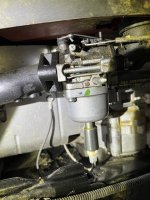
When I came back from lunch, I smelled fuel. Fortunately, I didn’t start the engine. It was parked level and when I checked, there was fuel running off the riding mower deck and fuel in the oil. I have added a photo. As you can see, the carb is really wet with fuel and it was dripping pretty good from the mower deck.

I am guessing this is some type of carburetor issue?IMG_3763.jpeg
 
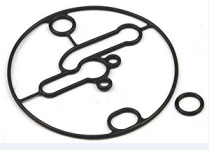
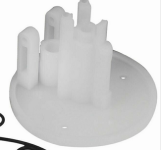
Appears that the Op has a 15.5 hp 310000 series engine with a Nikki carburetor. IF so then the carburetor bowl gasket has probably failed around the inlet tube. Two different bowl gaskets were used so the model, type, and date code are need to get the correct gasket.

It would be one these two gaskets. I suspect it is the one on the right as that is the one gives me the most problems.
1685273956264.png1685274098200.png
 
Last edited:
Thank you very much for the replies.

I do have an inline fuel valve. I use it to shut the fuel for maintenance and also when winterizing the riding mower. It’s not shown in the photo, but it’s off to the right, just before the fuel filter. Makes it easier to change the fuel filter by simply shutting the fuel line.

I’ll pull the carb off and see which gasket it is. I’ll also check the needle and seat while I’m at it. Is there any special tool required to remove the needle seat?

I’m a bit surprised that I would have carb issues already, the mower isn’t all that old. I have a smaller mower (Tecumseh) with the original un-serviced carb that is going on 20 years old.
 
The Nikki carburetor don't a separate per say as the fuel transfer tube is the plastic piece which the float is attached to.
1685292492763.png
These rather expensive and don't normally need changing.
 
Appears that the Op has a 15.5 hp 310000 series engine with a Nikki carburetor. IF so then the carburetor bowl gasket has probably failed around the inlet tube. Two different bowl gaskets were used so the model, type, and date code are need to get the correct gasket.

It would be one these two gaskets. I suspect it is the one on the right as that is the one gives me the most problems.
View attachment 64729View attachment 64730
I hate those gaskets, i mean why. They could've used the ages old design of the run of the mill carburetor, but they had to make it "better" i guess.
I keep several of each kind on hand because they either always tear, or don't go back in right. which im sure replacing them when you remove them is the correct thing to do.
 
Actually I love them
Because the main jet is in plastic tube it does not corrode anywhere near as much as the ones that are brass in zinc because there is no galvanic cell .
The jet itself rarely clogs and the only problem I regularly come across is the O ring around the fuel inlet tube seems prone to failure which allows the fuel to bypass the float valve .
The silly problem is of course hitting the main jet from the wrong side with higher air pressure than you should ever use when cleaning a carb and sending it into low earth orbit
I used to think the flooding was because of the O ring around the main jet but over time I have come to realize that if it does not fall out under it's own weight when the transfer tube is inverted then it is good and the problem will be the afore mentioned inlet tube O ring

Thus the main jet stays in place , get a cleaner passed through it, no carb cleaner as carb cleaner deteriorates the O ring , new gasket and job done in 5 minutes .
 
Actually I love them
Because the main jet is in plastic tube it does not corrode anywhere near as much as the ones that are brass in zinc because there is no galvanic cell .
The jet itself rarely clogs and the only problem I regularly come across is the O ring around the fuel inlet tube seems prone to failure which allows the fuel to bypass the float valve .
The silly problem is of course hitting the main jet from the wrong side with higher air pressure than you should ever use when cleaning a carb and sending it into low earth orbit
I used to think the flooding was because of the O ring around the main jet but over time I have come to realize that if it does not fall out under it's own weight when the transfer tube is inverted then it is good and the problem will be the afore mentioned inlet tube O ring

Thus the main jet stays in place , get a cleaner passed through it, no carb cleaner as carb cleaner deteriorates the O ring , new gasket and job done in 5 minutes .
must be because you're upside down over there.🙃🤣🤣
 
Back
Top