Repairs Troy Bilt Riding Mower13AP60TP766 Horse (2006) Keeps Blowing Fuse

edporch

Active Member
Hi,
I have a friend who has a Troy Bilt riding mower 13AP60TP766 Horse (2006).

It starts OK, but after running a minute or two, blows the 20 amp fuse.
On the flip side, it doesn't blow the fuse if it's just powered up without the engine running.

I'm having trouble finding a wiring schematic for that model to properly test the wiring.
I have the feeling it's a re-branded Cub Cadet model of some kind, but I don't know which.

We've done a thorough visual examination and can find no wiring problems.
But without a wiring schematic of that model it's difficult to go further.

Any advice would be appreciated. :smile:
 
As it only happens when the engine is running then it has to be connected to the alternator.
No 1 suspect is the rectifier pumping raw AC back into the engine.
Check the middle wire of the rectifier for voltage to ground, engine running.
Should be 12 to 15 V DC.
Then check it for AC, should be 0 V
 
I am experiencing a similar issue, 3 weeks ago my troy built bronco, (same model #) was fine. Been trying to find out now why the fuse keeps blowing when i crank it. Seems like a dead short somewhere. :(
 
In our case, my friend told me he measured voltages like described in Post#2.
He found AC voltage on the center tap of the Rectifier-Regulator.

In my last communication with him he was looking to buy a replacement Rectifier-Regulator and a new battery (as the battery won't take a charge).

I advised him to be sure the new battery is charged up before starting the mower, so he doesn't take a chance on straining the Rectifier-Regulator.

I'll report back again when I hear from him having replaced the parts.
 
If the rectifier bolts into the plastic blower housing make up a pair of ground straps and ground it at both sides to a different bolt on the engine.

The grounds break or corrode then you get a high resistance which pushes up the amps higher than the diodes can handle
 
If the rectifier bolts into the plastic blower housing make up a pair of ground straps and ground it at both sides to a different bolt on the engine.

The grounds break or corrode then you get a high resistance which pushes up the amps higher than the diodes can handle

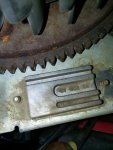
The picture my friend sent me the Rectifier-Regulator looks to be bolted into a metallic surface.
Rectifier-Regulator.jpeg
 
Those ones have to come out every now and then and clean off the corrosion because water will pool around the case, the case is zinc & it is bolted to steel so you will get galvanics when they get wet.

Thanks, I just passed this on to my friend.

Is this to help improve cooling?

Would a wire brush work for cleaning?
 
Back
Top