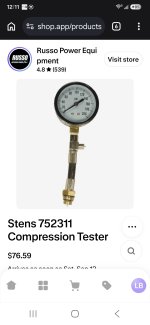
Compression Tester

Thanks! so much for the info. My first go to to fix a non start-up trimmer was an aftermarket carberator. I have about 80% success with that. I figured it's time to check compession on the other 20%.
What about the carberator plug along with new gaskets. Is that worth the time to remove and clean out instead of carberator replacement.
Thanks Again!

If you are asking about removing the welch plug to clean the carb and install a rebuild kit the answer is usually No to removing the welch plug and most generally rebuild kit cost about same as a replacement carb withtuneup kit not counting your time involved. Have to be careful or you can get more time and money into a trimmer than they are worth, especially if you are doing repairs for someone else I've noticed that on trimmer carbs the welch plug you need is usually not in the kit.
I've also found from experience that a bad replacement carb is not a good thing.


I've had good luck with HIPA replacement carbs from Amazon Prime, and FREE money back refund if no go.
 
AND
a mityvac pressure/vacuum tester is a good thing if you plan on working on chainsaws.

Do not confuse this mityvac leak test with a leak down tester that is used with a air supply that is used for checking 4 cycle gas engines for bad valves, rings, or head gaskets.
 
As Star indicated the compression testers with the schrader close to the cylinder are key for small engine work. I recommend the Mityvac MV5530. It's readily available for $75-$100 and it comes with spare O-rings and schrader valves. This is, of course, if you are looking to invest in a new complete kit, as opposed to just replacing the schrader. For me, my Mityvac is dedicated to small engine work and I have a few others I can use for autos (the Mityvac can be used for autos too!)

I can tell you from my personal experience the readings between the two types can be significantly different. The MV5530 reads much higher than the ones with the schrader at the gauge when checking small engines. In automotive use the Mityvac will be similar to the others.

Just my two cents! Enjoy!
 
Only been repairing small engines for 60 years or so, and there's still plenty to learn, but my go to compression tester is the rubber tip type. Used it 100s of times and has never let me down. This old guy sees it this way.... Pressure measured in psi is what this is about. Two or four cycle doesn't matter. If you have the tip firmly in place you'll find the psi or compression. Hot and cold results will differ, but Ive had great luck.
 
Only been repairing small engines for 60 years or so, and there's still plenty to learn, but my go to compression tester is the rubber tip type. Used it 100s of times and has never let me down. This old guy sees it this way.... Pressure measured in psi is what this is about. Two or four cycle doesn't matter. If you have the tip firmly in place you'll find the psi or compression. Hot and cold results will differ, but Ive had great luck.
Most likely you strapping or clamping down the handhelds then; unless, you have a third arm or it down with a foot. Most of us don't have a way the hold down an engine so a screw in compression gauge setup is the best for us with two arms.
 
AND
a mityvac pressure/vacuum tester is a good thing if you plan on working on chainsaws.

Do not confuse this mityvac leak test with a leak down tester that is used with a air supply that is used for checking 4 cycle gas engines for bad valves, rings, or head gaskets.
Differential tester....
 
Years ago I attended a service school and if I don't forget what I was told ---
They stated the schrader valve needs to be as close to the cylinder as possible, for the reason in a previous post. This is especially important when checking small engines such as chain saws and weed trimmers etc.
But with that said I usually don't use a compression gauge until after pulling the cord once or twice. After you pull a few you have a feel if the compression is high enough. If it feels good the a compression check will confirm the problem, especially on two strokes. If low pull the muffler off and look at the piston for scoring.
On 4 strokes most manufacturers do not recommend or will not publish compression figures due to the use of compression releases. On a twin listen to the engine when trying to start it. Do you hear both cylinders or just one.
Personally I preferr a leak down tester. If excessive just listen for the escaping air.
 
Years ago I attended a service school and if I don't forget what I was told ---
They stated the schrader valve needs to be as close to the cylinder as possible, for the reason in a previous post. This is especially important when checking small engines such as chain saws and weed trimmers etc.
But with that said I usually don't use a compression gauge until after pulling the cord once or twice. After you pull a few you have a feel if the compression is high enough. If it feels good the a compression check will confirm the problem, especially on two strokes. If low pull the muffler off and look at the piston for scoring.
On 4 strokes most manufacturers do not recommend or will not publish compression figures due to the use of compression releases. On a twin listen to the engine when trying to start it. Do you hear both cylinders or just one.
Personally I preferr a leak down tester. If excessive just listen for the escaping air.
Effective compression ratios of piston port two strokes are typically much lower than an equivalent four stroke of the same bore/stroke so there is no apples to apples comparison. Typically two strokes are anywhere from 5:1 to 7.5:1.
 
Back
Top