Generator Winter rider and snow blower battery and battery cable service.

Auto Doc's

Lawn Addict
Hello folks,

We are bracing for rain, snow and cold conditions down here in South Texas. To be vigilant I decided to fire up my generator and not wait until the last second. Well as luck would have it the positive battery cable end repeatedly arced and had to be manipulated for the engine to crank over. (Murphy's Law at work here).

So, at 9 PM this evening before the bad weather moves in, I had to make a new cable.

I know for many of you, the weather has already been much worse, but don't forget to check and clean your battery and cable ends before the "fit hits the shan".

Batteries and the cable ends typically fail the most when you need the most.

Stay warm.
 
What I see here is the use of el cleapo wire terminals failing that are corroded by sulfuric acid or by arcing from loose connections. I always replace them with cable lug terminals but that requires a hydraulic crimper. Now there is other half way crimpers out there; although, make lousy crimps.

Batteries do like in either cold or hot weather but they can fail at anytime. Case in point is where you crank up your vehicle in the morning, drive 25 miles to Tramlaw, Shut it down, then realize you parked on the wrong side of the parking lot. Then when you go start your engine nothing but a click. After getting a jump off and $200 later at the Auto Zone you're back in business. This one actually happen to me back in the Fall when I had replace my glasses due some big footed idiot crushed them. Guess who was the big footed idiot?

It was the third time this type of battery failure has happen to me. No warning signs.
 
Hi Star Tech,

This year has been my year for multiple battery replacements. I have had to purchase 3 different vehicle batteries at just over $200 dollars each, 2 riding mower batteries that were over 5-years old, a John Deere 3010 Propane tractor battery and a battery for my Harley trike.

For my generator cable end problem, I should have caught it way back when the weather was warmer, but the light rain, high humidity and pending cold weather coming in moved it immediately to the front of the list of things to do.

For the battery cable eyelet terminal ends, I crimp them lightly in a vice or with large vice-grip pliers, then solder them. I've never trusted crimping without soldering to ensure a good bond, that way no corrosion creeps in.
 
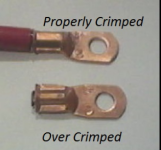
Oh my hydraulic can crimp so tight that strands can fused as one if I wish but that is over crimping. I rather just use conductive grease with antioxidant and heat shrink tubing. That way acid can't easily creep up the cable.
1769028623070.png

And she looks dead.
1769028740537.png
She is just sleeping.
 
A proper crimp is where the soft copper DOES turn into a solid block of copper. If you cut open a weak crimp, you get stranded copper for example. Wasn't crushed enough.

If you want corrosion protection on a battery terminal, run a small propane torch with some solder on the exposed copper areas.
 
Well do it your way and I do it my way. Never had one to fail; unless, I using one el cheapo crimpers that many solder-less terminal kits comes with. That why I have a ratchet type. And I do a lot open barrel and splice crimps.
 
I know for sure over crimping will lead to a break sooner than later. That is why I soft crimp for a light crush on the strands and then finish with solder. After cooling, I apply some preservative spray.

Ratchet crimpers work great just the same though, but they are expensive.
 
I know for sure over crimping will lead to a break sooner than later. That is why I soft crimp for a light crush on the strands and then finish with solder. After cooling, I apply some preservative spray.

Ratchet crimpers work great just the same though, but they are expensive.
Never have used solder after crimping larger gauge wire on battery terminals. I will try it. Common sense tells me it helps secure the wire better and keep out corrosion.
 
I know for sure over crimping will lead to a break sooner than later. That is why I soft crimp for a light crush on the strands and then finish with solder. After cooling, I apply some preservative spray.

Ratchet crimpers work great just the same though, but they are expensive.
Yes they are but for a professional shop they are justifiable. Matter of fact I got two here as I had to have a set jaws modified for F56 male terminals and the manufacture didn't provide replacement jaws. The hydraulic crimper is for cable lugs for 8 gauge and larger wire. These cable lugs I use you are not going ratchet crimp them and these you have to use the large gauge die size than the cable size. For example I use the 4 gauge on 6 gauge wire. This crimper is actually cost the same as the ratchet crimper did. Around $70. I have been very please with crimps

Soldering is fine for the terminals but you also got to think about the cable side too. If you don't seal the connection between the cable lug and the wire insulation you are just asking for corrosion of the wire as it just wicks up any moisture, be it water or acid. Most other wire termination is as critical as battery or other large size. 10 gauge and smaller is usually not expose to the same things as the battery wire except some that are directly connected to batteries.
 
Hi StarTech,

I forgot to mention in my original post that I also use heat shrink tube once the eyelet has cooled well. It is good to slip a short section on before the crimping and soldering. This seals out moisture.

The trick is to slip it far enough up the cable section, so the heat does not get to it prematurely.

If I am out of shrink tube, I use a couple of coats of liquid vinyl tape.
 
Back
Top